|
|


Summit County’s short-term rental moratorium has officially ended, and in its place is a short-term rental ordinance that places the Peak 7 neighborhood in a neighborhood zone.
The vote took place during an extended Summit Board of County Commissioners special meeting Thursday, Dec. 16, which marked the last day of the county’s 90-day moratorium and the deadline for when the board needed to pass a new short-term rental ordinance. After hours of public comment about whether the Peak 7 neighborhood should be classified as a resort or neighborhood zone, the commissioners came to a decision in a vote five hours after the meeting started.
The commissioners originally voted to classify the neighborhood as a resort zone during the ordinance’s first reading in late November. In the weeks leading up to the second reading, the county received a substantial amount of public input leading up to the vote on the second reading. Case in point: Nearly 100 virtual attendees tuned in to Thursday’s meeting and another few dozen spoke in person. Most of the attendees spoke about Peak 7, and over half of those who spoke were in favor of designating the area as a neighborhood zone.

It's no secret that Colorado is one of the top winter getaway spots in the country, known for its ski slopes and picturesque scenes of snowcapped mountains. According to a recent data analysis, two local towns are among the best places to visit during winter nationwide, but for very different reasons.
Writers at moveBuddha sought to provide their readers with a list of spots to "flee the cold or embrace it," designing a winter getaway list that's not just about snow. They divided towns into four themes – snow & slope, sun & sand, cozy & cuddly, and trails & trekking – and crunched some numbers, with two spots in Colorado making the cut to break into the top five of their respective category.
The highest ranking place in Colorado was Breckenridge, ranking first in the 'snow & slope' category. Home to a world-famous ski resort, a main street filled with shops and aprés ski spots, and a number of beloved winter events, Breck is a top year-round tourism spot in the Centennial State. Its close proximity to Denver and the rest of the Front Range makes it easy to get to, plus this town is well-known, thanks to a lot of positive press. For example, it was also recently dubbed a top spot in the country for Christmas celebrations.
Though it's not too surprising to see Breckenridge on this list, the list wasn't just created based on assumptions or opinion. The 'snow & slope' towns were ranked based on favorable skiing temperatures, average annual snowfall, proximity to ski resorts, and number of ski lifts adjusted for population differences.
While Breckenridge earned these honors based in-part on their local skiing, the annual International Snow Sculpture Championships also got a shout-out, with the publication calling the town "a winter wonderland."
Breckenridge Ski Resort turns 60 years old this week. To mark the occasion, Breckenridge Heritage Alliance has a new exhibit opening Thursday, Dec. 16, the same day the resort opened in 1961. Called “60 Years of Breckenridge Ski Resort History in 60 Objects,” the unique collection doesn’t follow a chronological history of the resort like museumgoers might expect.
Instead, it relies on the displayed artifacts to tell the story of how the resort was shaped over the years.
“It was important for every object to have its own story,” Breckenridge Heritage Alliance Executive Director Larissa O’Neil said. “The resort has had kind of a unique history. It wasn’t founded by the 10th Mountain Division veterans. … We just felt like we could do a neat job of doing a display that wasn’t chronological, that wasn’t along a timeline, that was just a funky collection of things that together tell this complete history in a unique way.
The first major winter storm of the season lived up to expectations, dropping double-digit snow totals as some Summit County ski areas over the past 48 hours.
Copper Mountain Resort got 11 inches out of the storm system through 5 a.m. Friday, reporting 6 inches Thursday and 5 additional inches Friday. Breckenridge Ski Resort reported a total of 10 inches in 48 hours, tallying 5 inches each day.
Keystone Resort and Arapahoe Basin Ski Area didn’t fare quite as well, with each reporting 5 fresh inches in 48 hours. Loveland Ski Area, just over the Continental Divide, reported 4.5 inches.
The resorts should have an additional 2-5 inches of accumulation on their 5 a.m. Saturday reports with heavy snow expected to continue on and off through Friday afternoon, according to forecasting site . Saturday is expected to be windy, and the National Weather Service issued a high wind watch with gusts up to 75 mph.
After the storm rolls out, the weekend is expected to be dry, but the next chance for snow isn’t far behind. The next storm is expected Wednesday, Dec. 15, and even more snow could arrive the following weekend.
With the town of Breckenridge passing its new short-term rental regulatory fee, properties previously exempt from the administrative fee will now have to pay $400 per bedroom to the town come Jan. 1, 2022.
The only short-term lodging properties exempt from the fee are ones registered as a lodge with the town, which applies to traditional hotels owned entirely by one person or corporation.
“Per our town code, a lodge is a property with multiple rental units that is owned by one entity,” accommodations compliance administrator Bela Del Valle said. “… Breckenridge does not have very many of those.”
Del Valle said lodges will still have a different type of business license, and they don’t need short-term rental licenses. Properties that currently hold a lodge license in Breckenridge are the DoubleTree by Hilton, the Breck Inn, Skiway Lodge, the Residence Inn by Marriott, the Fireside Inn, the Bivvi Hostel, Gravity Haus and Welk Resorts.
Previously, properties with short-term rental licenses that had 24-hour front desk, security and phone service were exempt from the administrative fee. Examples of exempt properties include Beaver Run Resort, Crystal Peak Lodge, Grand Colorado on Peak 8, Main Street Station, Mountain Thunder Lodge and One Ski Hill Place. These properties are still exempt from the new license cap of 2,200, but are not exempt from the regulatory fee.
This has to be the most convoluted, idiotic move by a town council since Breckenridge was founded. Can anyone understand why a "lodge" as Breckenridge has defined it is exempt from this new tax? And why properties like Beaver Run, Grand Colorado on Peak 8, etc. are exempt from the new license cap of 2,200.
December is here, meaning Christmas is right around the corner, and Summit County communities are itching to celebrate. Following in the footsteps of Frisco, Keystone and Copper — Silverthorne and Breckenridge are turning on the holiday lights. Other festivities happening soon include the Race of the Santas and the long-awaited return of Ullr Fest.
Throughout the year, Summit County leaders have taken numerous steps to increase the amount of attainable and affordable housing for locals, and one such measure is revamping its short-term rental license regulations. Over the past few months, the county’s planning department has led the charge in gathering public feedback and collecting data to determine the best course of action for its program.
When condos, townhomes and other properties turn into short-term rentals, it effectively removes these properties as potential housing for locals. Summit County leaders believe these changes will indirectly “stop the bleed,” or slow the pace of short-term rental unit conversions. Others aren’t so sure.
Kyle Rogers and his wife, Marlene, own a second home outside of Breckenridge in unincorporated Summit County. The couple said they remain unconvinced that these new regulations will create housing for full-time residents.
“If you cap these (short-term rentals) at a certain number less than what they are being rented for, those (guests) will simply go elsewhere, and they’ll take their money with them, and they’ll go to communities where they can have that superhost-like experience in a mountain home,” Rogers said.

Why so many people are interested in purchasing a second home in Summit County isn’t a mystery. The area boasts plenty of recreational opportunities year-round, the scenery is impeccable and it’s the first big stop along Interstate 70 that boasts four ski resorts all in one county.
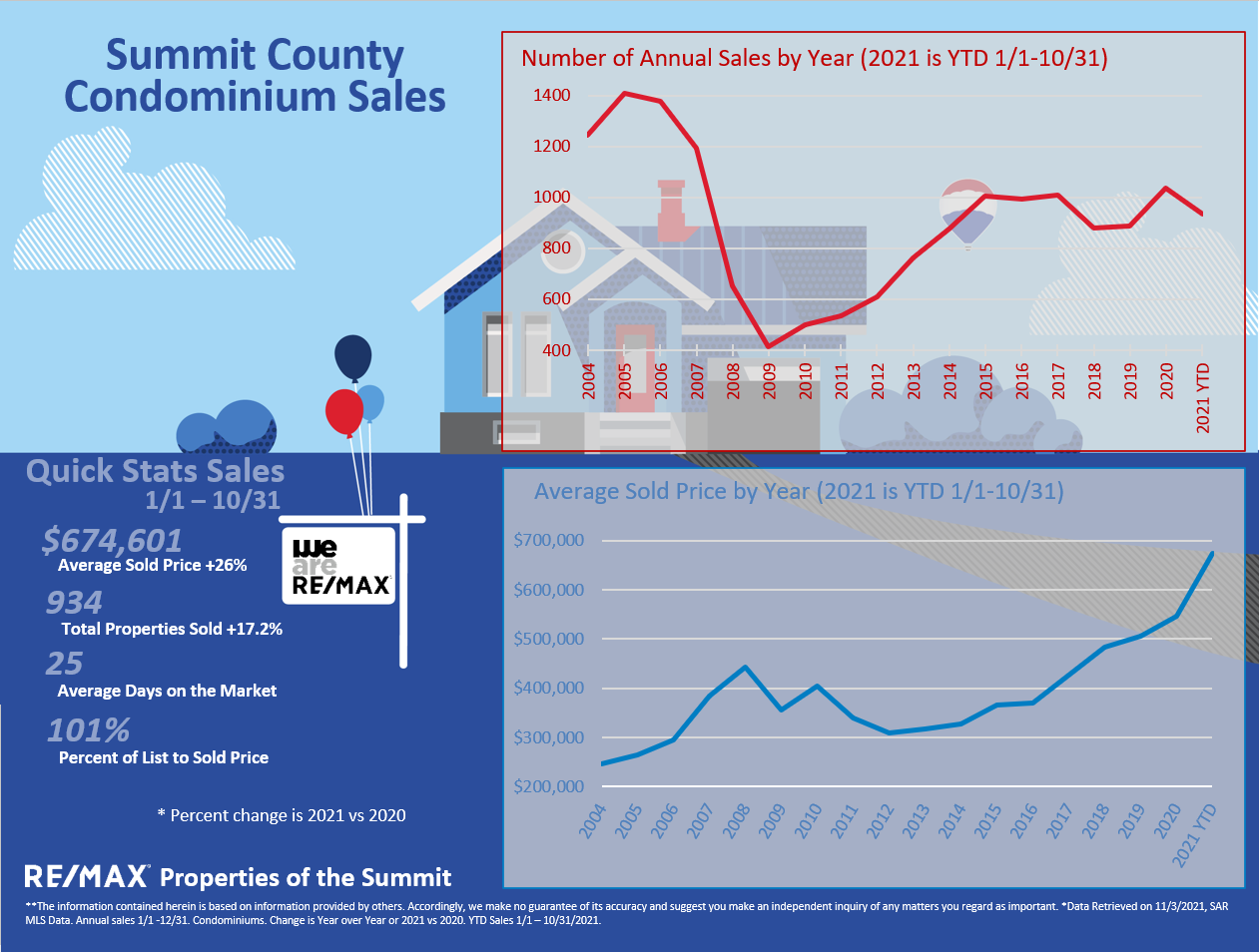
These big perks combined with the pandemic’s boost in remote working has created quite the hot real estate market in Summit County all year long, and especially so for the luxury market.
In total, sales for luxury units were the strongest in the third quarter of 2021, according to Land Title Guarantee Company’s monthly report.
The third quarter of the year raked in roughly $499,084,304 in gross volume for sales priced at $1 million or more. Second quarter was close behind at $419,376,361 in gross sales. First quarter lagged behind at $240,619,600.
Like the more affordable residential real estate market, buyers might have to exercise patience if they are looking for a specific piece of property. Not only is there not as much inventory on the market, but according to the Summit Realtors Association, the average number of days until it sold in Breckenridge for October was 31, which is down 72% compared to the same month last year. The association reported last year that the average number of days a unit was on the market until it sold was 112.
The entire Breckenridge short-term lodging community will have to pay $400 per bedroom to the town at the start of 2022 after Breckenridge Town Council voted 5-2 to pass its new regulatory fee at the Nov. 23 meeting.
After the first reading of the ordinance, council wanted feedback from its new tourism overlay task force on the fee amount as well as potential exemptions. Council members Dick Carleton and Kelly Owens, who sit on the task force, said the group was not supportive of the idea of exemptions.
“They really felt that if we’re going to do this, it should be the same for everyone,” Carleton said. “It seemed like there was consensus on that one.”
Several council members were thrown off by the feedback considering the exemption they wanted to include was for locals who rent out their primary residence 21 or fewer days per year. Owens said the task force’s point was that if the fee is meant to help create more workforce housing opportunities for the community, then as many people as possible should pay it.
“There was a significant feeling of, ‘If you’re going to be charging a fee … trying to raise money for different housing programs, then don’t do a bunch of exceptions. Just move forward with the fee,’” Owens said.
Council members Dennis Kuhn and Carol Saade voted “no” again on second reading because they are nervous about the impact the fee will have on the lodging community with such a quick turnaround. Saade said if council was having this conversation in June and giving the community more time to prepare, she would be on board, but she said she is not comfortable doing so now without more of a heads up. Kuhn agreed and said he would have liked to see the fee start out even smaller to give folks more time to adjust.
Courtesy Summit Daily News.
|